Stop the Panic: How Timed Practice Actually Tames Exam Anxiety
The Strange Paradox of Doing Absolutely Nothing
Last weekend in Bangkok, hundreds of people gathered simply to sit still for an hour, an act of rebellion against the constant hum of digital noise and productivity expectations. It is a reaction many students and parents will recognise. The pressure to constantly 'do'—to revise, to attend extra lessons, to fret over mock results—has created a state of perpetual agitation. We see this in the headlines, from record-breaking student award ceremonies in Hong Kong to the global anxiety over AI taking our jobs, as reported by The Guardian. When everything feels urgent, the temptation is to either sprint until you burn out or freeze entirely.
For students preparing for the IB, IGCSE, or HKDSE, this 'freeze' response often manifests as exam anxiety. It is not necessarily a lack of knowledge, but a reaction to the ticking clock. You know the material, but the moment you sit for a timed test, your heart rate spikes and your working memory seems to vanish. If you can learn to manage that physiological response in a controlled environment, the actual exam day becomes just another Tuesday.
Why Your Current Revision Approach Might Be Failing
Many students spend hours highlighting textbooks or re-reading notes. This feels productive, but it is passive. It gives you a false sense of security because the information is already there in front of you. When you move to a timed practice test, you are suddenly forced to retrieve that information from scratch, which is cognitively exhausting. This is why you feel that familiar dread: you are moving from a low-stress 'recognition' task to a high-stress 'production' task.
The goal of timed practice isn't just to see how many marks you get; it’s to build the 'muscle memory' of taking a test. If you are a parent watching your child struggle, understand that this anxiety is often a symptom of avoiding the discomfort of being wrong. By practicing under timed conditions, you turn that discomfort into a predictable, manageable part of the process, rather than a surprise that hits you on the day of the exam.
How to Run a Timed Simulation at Home
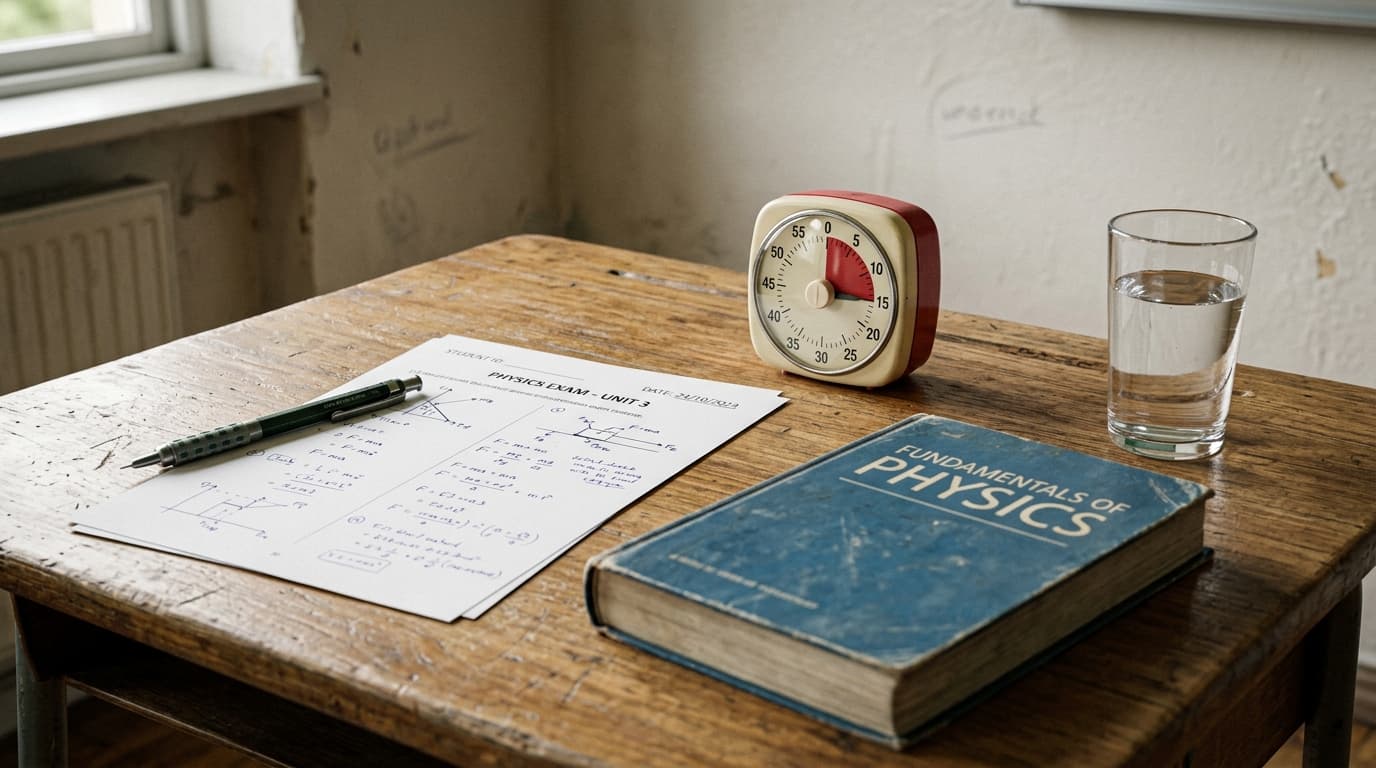
If you are a student, stop telling yourself you need 'perfect' conditions to practice. You don't need a silent, empty hall. You need to get used to the friction. Start by taking a single paper—or even just a section of one—and setting a timer for 75% of the allocated time. If an IB Chemistry paper gives you 90 minutes, give yourself 67 minutes. This builds a buffer of mental 'slack' that will make you feel significantly calmer when the real exam arrives.
During this time, force yourself to write through the blocks. If you get stuck on a six-mark mechanics question, don't look at the mark scheme immediately. Put a star next to it, skip it, and come back. This trains your brain to manage time and emotional regulation under pressure. When you finish, the post-mortem is more important than the paper itself. Spend twice as long reviewing your mistakes as you did writing the paper.
Supporting the Process Without Adding to the Load
For parents and teachers, the most helpful thing you can do is de-mystify the exam environment. Anxiety thrives in the unknown. When a student knows exactly what to expect from an exam paper, the 'scary' factor drops significantly. Don't frame these sessions as 'tests' that determine their worth, but as 'training sessions'—similar to how an athlete doesn't win the game during practice, but does the hard work required to not lose it later.
Keep your own anxiety in check. If you are hovering over a student while they work, you are adding to their pressure. Instead, provide the structure—a quiet desk, a clear start time, a promise of a post-practice coffee—and then step back. Allow them to struggle with the clock. It is in that struggle that the real learning happens, not in the hours spent highlighting notes.
Three Common Myths About Exam Prep
The biggest myth is that you must finish every single past paper available to succeed. You don’t. Five papers done with deep, forensic analysis of your errors are worth twenty papers done just to 'get through them.' Another myth is that you need to be a 'genius' to handle time pressure. You don't; you just need to be a strategist. You need to know which questions to skip and how to structure a basic answer when you are running low on time.
Finally, stop believing that the environment needs to be 'safe' to be effective. While safety is vital for mental health, academic 'safe zones' where you only practice topics you enjoy are a trap. You have to practice the topics you hate, and you have to do it when you are tired. That is how you build the resilience necessary to perform when the pressure is at its peak.
Building Confidence Through Consistent Simulation
Preparation is about reducing the number of variables on exam day. If you use tools like Revui to generate targeted, timed practice sessions, you can strip away the mystery of the exam, leaving you with nothing to do but show what you have learned.