Why Timed Practice Tests Are Your Best Defense Against Exam Panic
When the Familiar Classroom Feels Like a Pressure Cooker
We have all seen it: the student who knows the material inside and out during a one-on-one tutorial, but whose mind goes blank the moment they see a proctor walking down the aisle. Whether you are prepping for the HKDSE, IB, or A-Levels, the transition from 'learning' to 'performing under pressure' is where most students stumble. It is not necessarily a lack of knowledge that causes the panic; it is the sudden, artificial intensity of a timed environment that disrupts the brain's ability to recall information.
This isn't just about nerves—it is about rhythm. When you sit down for a practice paper without a timer, you are essentially rehearsing a play without ever checking the stage timing. You might know your lines, but you haven't accounted for the pace required to make it to the final act. Reducing exam anxiety isn't about ignoring the clock; it is about making the clock your teammate.
The Real-World Cost of Exam Uncertainty
In international education, the stakes are rising. We see headlines from the UK about students falling behind due to socio-economic gaps, or the growing frustration in Portugal over digitised marking failures, which creates a pervasive sense that the system is volatile. When students and parents feel that the ground is shifting beneath them, that anxiety is naturally projected onto the next set of exams. It becomes less about the subject matter and more about surviving a process that feels increasingly opaque.
When schools push for new, untested digital assessment systems or pivot toward technical subjects like AI and manufacturing, the pressure on the student to adapt quickly intensifies. If you are already worried about whether your hard work will be fairly graded or if your specific exam board is changing its rubric, the last thing you need is the added variable of not knowing if you can finish a paper on time. Taking control of the timing is one of the few variables you can actually lock down in an unpredictable educational climate.
How to Build a High-Performance Revision Rhythm
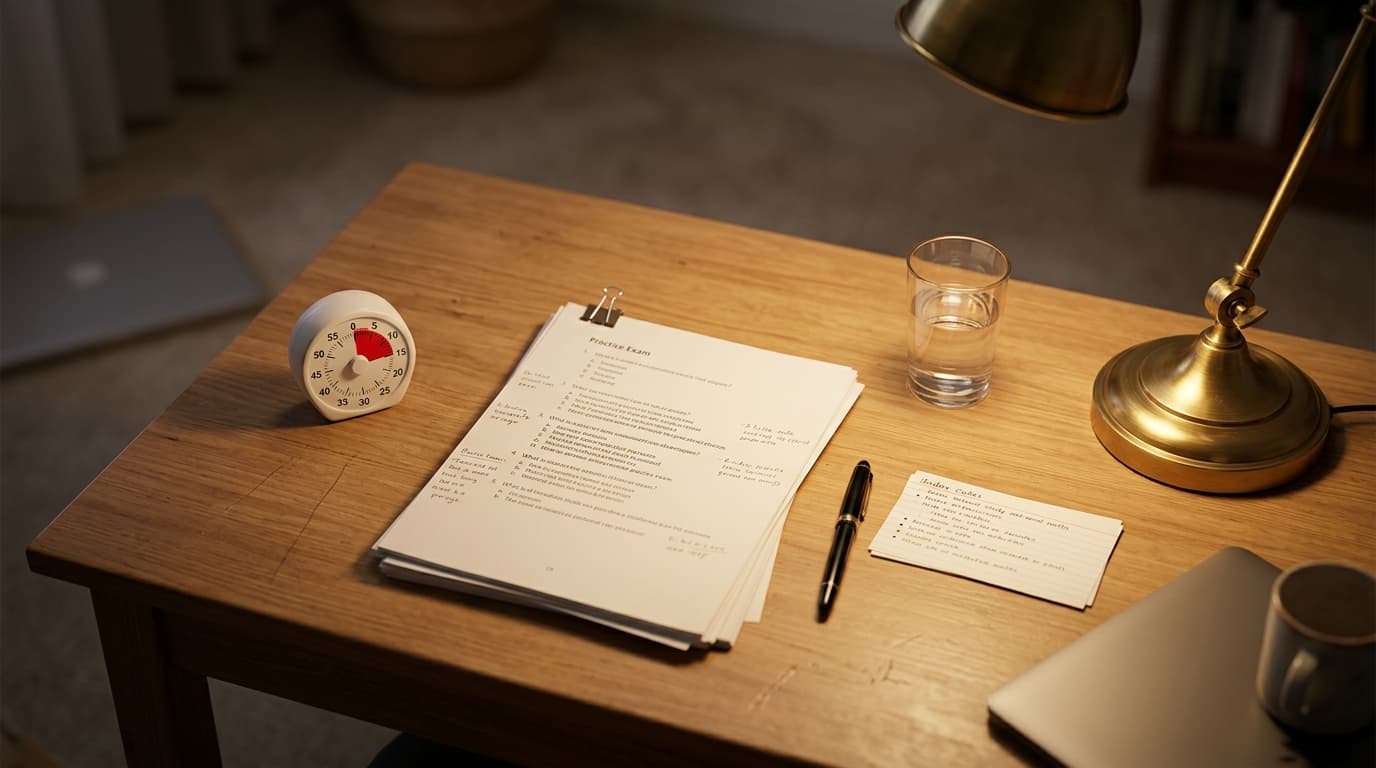
The most common mistake students make is doing 'practice' by simply reading through notes or rewriting summaries. That is passive review, not practice. To build confidence, you need to simulate the environment of the exam room. Start by taking a single section—perhaps the mechanics portion of a Physics paper or the document-based question in History—and set a timer for the exact amount of time you would be allotted in a real exam. Do not pause it. If you get stuck, force yourself to make a decision and move on. You are training your brain to handle the 'stuck' feeling.
After the timer goes off, don't just check your score. Look at the questions you left blank or the ones where you wrote a messy, incomplete sentence. That is where your anxiety lives. By identifying exactly where your time management breaks down, you turn a vague, scary feeling of 'I might not finish' into a concrete problem you can solve: 'I need to spend 30 seconds less on the multi-choice section to give myself more room for the essay.'
Helping Students Without Adding to the Noise
For parents and teachers, the instinct is often to hover or demand more study hours. But if you see a student struggling with anxiety, adding more hours is rarely the answer. Instead, help them build a 'low-stakes' environment for high-stakes practice. Encourage them to take a timed test in a space that isn't their bedroom, or help them track their time-per-question metrics so they can see their own progress objectively. When they see, in black and white, that they have improved their completion speed by five minutes, that is a massive win against the 'imposter syndrome' that often fuels anxiety.
Teachers can support this by emphasizing the 'why' behind the time limits. When students understand that the clock is there to ensure fairness and structure—not to trap them—it changes their relationship with the exam. If you are a teacher, show them how to triage a paper. Teach them that they don't have to answer the hardest question first. Giving them permission to skip, park, and return to a question is a powerful tool for lowering the heart rate during a test.
Common Myths That Undermine Your Success
The biggest myth is that you need to be perfectly prepared before you attempt a timed test. Many students put off timed practice until a week before the exam, thinking they need to know everything first. This is a recipe for disaster. If you wait until you are 'ready,' you will never be ready. Timed practice is a diagnostic tool, not just a final exam. It is meant to reveal your gaps early, while you still have weeks or months to address them.
Another trap is the 'marathon session' mentality. Some students think that sitting for three hours straight is the best way to practice. Often, this leads to fatigue and diminished returns. It is far more effective to do short, intense bursts of timed practice—perhaps 30 minutes at a time—where you can review your performance immediately after the clock stops. Quality of review is always superior to quantity of output.
Mastering the Clock to Reclaim Your Calm
The goal is not to turn yourself into a machine, but to build enough familiarity with the pacing of your exams that the 'test' part of the experience becomes background noise. By using tools like Revui to track your timing across different question types, you shift your focus from worrying about the outcome to perfecting your process. Once the process is automatic, the anxiety simply has nowhere left to hide.
Further reading
- Schools to offer technical subjects to pupils from age 14 in England, Burnham says — BBC Education
- Calls grow ‘to flunk’ Portugal’s education minister amid exam marking fiasco — The Guardian Education
- Free school meal pupils falling further behind their peers, report warns — BBC Education
- Education, health fees among key concerns — China Daily
- Hong Kong garrison holds reception marking 99th anniversary of PLA’s founding — South China Morning Post