HKDSE Revision: Strategies That Actually Work in the Final Stretch
Why the final months feel heavier than they should
The air in the house changes around this time of year. As the HKDSE draws closer, the quiet hum of study routines often gives way to a palpable tension. It’s not just the curriculum content that weighs on students; it’s the sense that every minute spent away from a textbook is a minute lost. We see this across the globe—whether it is students in the UK grappling with shifting university loan terms or students in Gaza facing unimaginable barriers to their education, the anxiety of 'what comes next' is a universal burden. In Hong Kong, with the government pushing for school mergers to navigate a shrinking student population, the landscape of secondary education feels more precarious than ever. For a student, this manifests as a nagging feeling that you aren't doing enough, even when you are exhausted.
This is the time when the 'hustle' mentality starts to backfire. We talk a lot about intensity, but in the final stretch, consistency beats intensity every time. The goal is to move from passive reading—which feels like work but rarely yields results—to active retrieval. If you find yourself highlighting your notes for the third time, stop. You are not learning; you are just decorating your textbook. That feeling of comfort is a trap, and it is exactly what leads to the 'I knew it at home but forgot it in the exam hall' phenomenon.
Stopping the cycle of passive, low-impact study
One of the most persistent myths in revision is that you need to be glued to your desk for eight hours a day to be successful. As recent reports on AI's impact on human thinking and connection suggest, we are becoming increasingly worried about how technology affects our cognitive depth. In the study room, this means we often use devices to 'search' for answers rather than 'thinking' through them. When you hit a roadblock in a Chemistry calculation or an Economics graph, the temptation to jump to the answer key or a generative AI chatbot is immense. Resist it. The moment of frustration—that specific point where your brain feels like it’s grinding to a halt—is exactly where the learning happens.
If you are a student, start by closing the tabs that don't directly serve the task. We are seeing a global conversation around screen time, with platforms like Snapchat even acknowledging the need for boundaries. If an app can implement limits for your well-being, you can certainly implement them for your grades. Treat your concentration like a finite resource. If you have to choose between two hours of 'distracted' work and thirty minutes of 'deep', phone-free, closed-book practice, the latter will win every single time.
Building a routine that survives the pressure
For students, the most effective strategy this week is to move entirely to past-paper simulations. Do not 'study' a topic; test your ability to retrieve information about that topic under time pressure. If you are doing a Physics paper, don't just look at the mark scheme; look at the examiner’s report to see where students typically drop marks on specific mechanics questions. This is about identifying your 'leaky buckets'—the specific concepts that you think you understand until you are forced to write them down without notes.
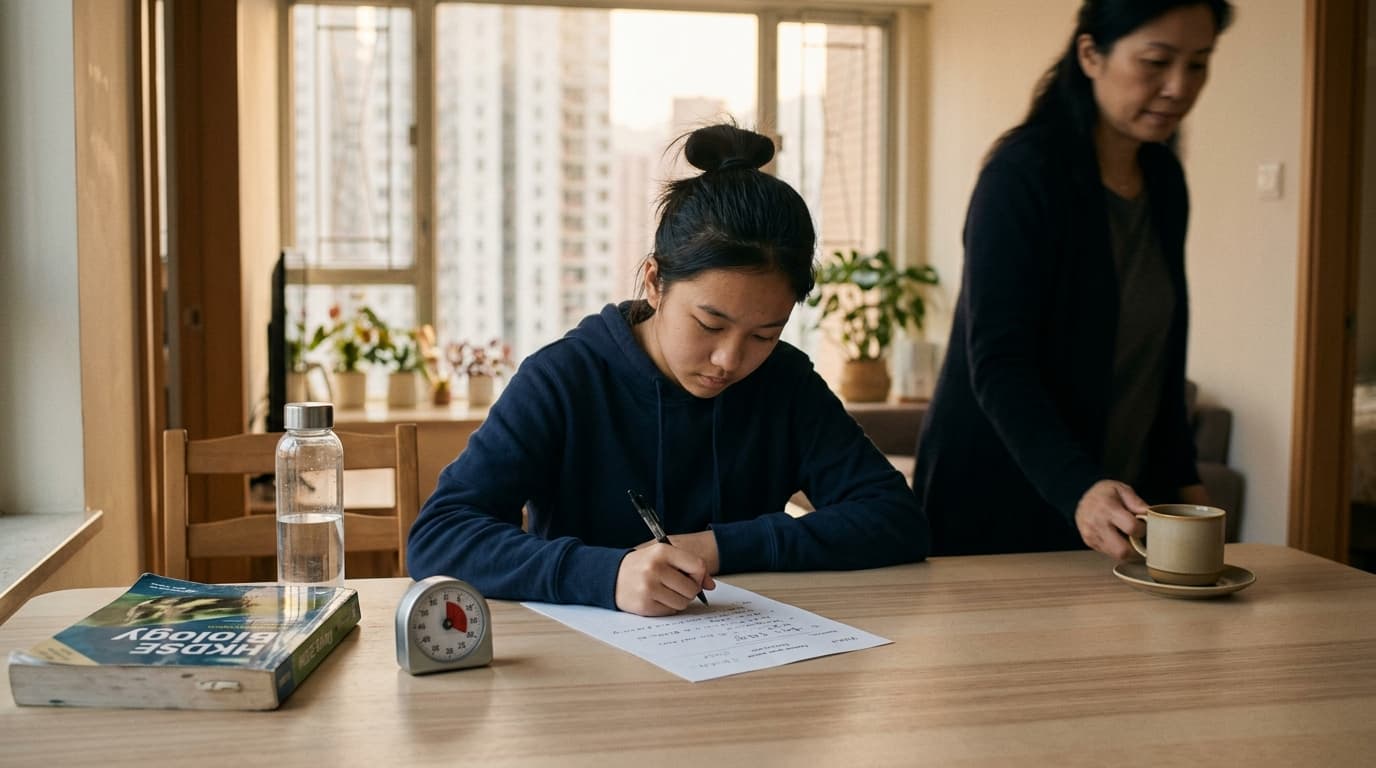
Parents, your role here is not to be a tutor, but to be an architect of the environment. You don't need to understand the nuances of the HKDSE syllabus to provide value. You can help by enforcing a 'phone-away' zone or ensuring that the dinner table remains a space free from discussions about predicted grades. The cost-of-living discussions and the shifting landscape of university admissions are stressful enough for students to carry without adding parental expectations into the mix. Keep the home environment a place of stability, not a secondary classroom.
The trap of the 'perfect' study plan
A common mistake is spending more time creating a beautiful, color-coded revision calendar than actually revising. It feels productive, but it is procrastination in disguise. Your plan should be flexible enough to allow for the days when you are simply too tired to function. If you have a bad day where you accomplish nothing, don't try to double your workload the next day. That path leads directly to burnout. Instead, reset and move forward. Remember that even experts in other fields, like the crafters highlighted in recent design features, found success through trial and error, not through a rigid, flawless initial plan.
Another trap is the 'all or nothing' mindset. Many students believe that if they cannot study for a full three-hour block, it’s not worth studying at all. This is false. A focused 20-minute burst of active recall on a difficult set of English comprehension questions is infinitely better than an hour of zoning out while reading history notes. Be ruthless about your time. If a topic is already a strength, stop spending hours on it just because it makes you feel good to get questions right.
Finding clarity in the final push
As you head into these final weeks, remember that exams are a test of how you handle specific, predictable constraints, not a test of your entire intelligence. The tools you use—whether they are physical flashcards or platforms like Revui—should be designed to expose what you don't know, not to reassure you about what you already do. Use these tools to systematically close your knowledge gaps rather than just cycling through the same material.
Stay grounded in the process, keep the distractions at bay, and trust that the work you do in the quiet, uncomfortable moments of revision is what will show up on the paper. You have the resources; now you just need the discipline to focus them where it matters most.