Fixing the IGCSE Science Paper 2 Trap: Why Multiple Choice Isn't Easy
The deceptively dangerous nature of multiple choice
Every exam season, I see the same pattern. A student walks out of the exam hall feeling buoyant, convinced they 'aced' the multiple-choice section because they finished ten minutes early. Then, results day arrives, and that Paper 2 score is significantly lower than their structured papers. It is a classic trap. We often treat Paper 2 as a test of intuition, but in the IGCSE science curriculum, it is a test of precision.
The tension is palpable right now. With news that education sectors in places like the UK are facing budget cuts and a lack of female representation in science curricula, as reported by the BBC, students are increasingly left to navigate these complexities on their own. When you are studying in a system where the resources or the nuance of the subject matter feel thin, relying on a 'gut feeling' in Paper 2 is a recipe for disaster. The distractors in these questions are designed to exploit exactly that kind of overconfidence.
Why current classroom trends make revision harder
There is a growing concern about the role of technology in our schools. While digital tools are everywhere, clinicians are now warning that excessive screen time—often consumed during late-night revision sessions—is leading to real health issues, including vision problems. When you pair this physical strain with the pressure to perform in an international school environment, it is no wonder students struggle to focus on the fine details of a mark scheme.
Furthermore, as we see a decline in humanities and a shifting landscape in how subjects are valued, the pressure on STEM subjects to be the 'guaranteed' path to university increases. Parents are understandably anxious about these stakes. If you find your child scrolling through TikTok during what was supposed to be a session on ionic bonding, recognize it as a symptom of a broader environment that lacks the structured guidance it once had. The goal is to make revision shorter, sharper, and far more deliberate.
Concrete tactics for conquering the Paper 2 format
If you want to stop losing marks, you have to stop reading the answer choices first. It sounds counterintuitive, but the moment your eyes hit the four options, your brain begins to justify which one 'looks' right, even if it is a clever distraction. Instead, cover the options with your hand. Solve the problem on the empty space of your question paper as if it were a short-answer question. Only once you have your own answer should you look to see if it matches one of the options.
Also, watch out for the 'all of the above' or 'none of the above' traps. When you encounter a question with these, evaluate every single statement individually. Treat a question with three statements as three separate true-or-false mini-questions. If statement one is false, you can immediately eliminate half your options, which significantly shifts the probability in your favor. It is a slow, mechanical process, but it is the only way to avoid the 'distractor' pitfalls that examiners spend hours perfecting.
How parents and teachers can support better focus
Parents, your role here is not to be a tutor, but to be an auditor of environment. If your student is claiming to study for two hours, ask to see the 'evidence' of the work. If there is no paper trail—no messy calculations, no scribbled diagrams, no annotations on a past paper—then they aren't studying; they are just reading, which is the least effective way to prepare for a science exam. Encourage them to use a physical timer to break their session into 25-minute sprints to avoid the screen-fatigue clinicians are warning about.
Teachers, meanwhile, should be pushing students away from the 'guess-and-check' mentality. During mock reviews, do not just tell them which letter was the correct answer. Force them to explain why the other three options were scientifically incorrect. When a student can explain why a specific distractor is wrong, they have truly mastered the concept. It turns a simple review into a deep-learning exercise.
Avoiding the common myths of exam preparation
The biggest myth in IGCSE science is that you can 'cram' for Paper 2 by doing hundreds of random questions without reviewing the errors. Doing a thousand questions is useless if you don't understand the pattern of your mistakes. Are you consistently losing marks on graph interpretation? Is it the unit conversions? Or is it a fundamental misunderstanding of core definitions? Most students just mark their paper, see a score, and move on.
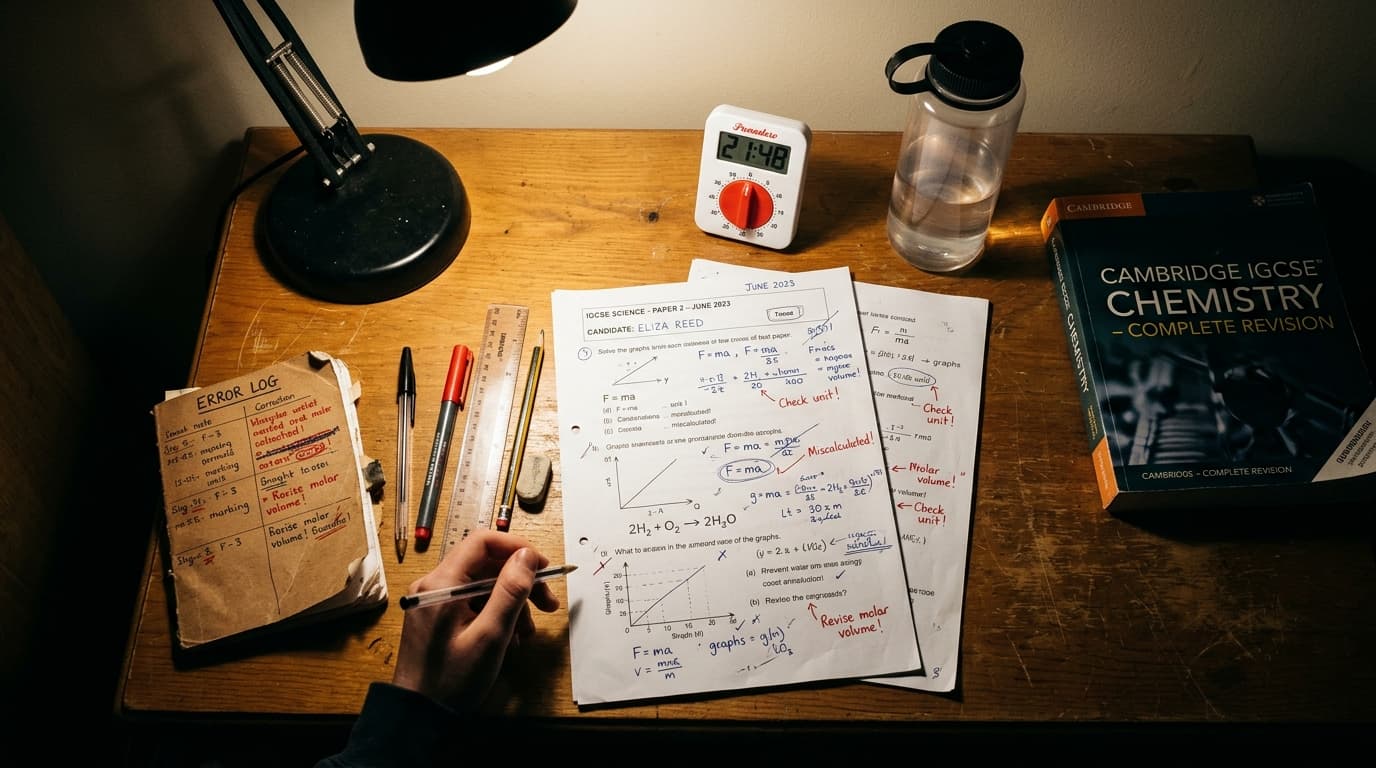
You must keep an 'Error Log.' Every time you get a Paper 2 question wrong, write down not just the right answer, but the specific reason you got it wrong. Was it a misread word? A missing unit? A gap in knowledge? This log becomes your most valuable resource in the final week before the exam. It transforms your revision from a passive exercise into a targeted surgical strike on your own weaknesses.
Turning effort into consistent exam results
The key to mastering Paper 2 is consistency over intensity, and using tools like Revui to track those specific error patterns can help you move from aimless practice to targeted improvement, ensuring you spend your limited energy on the topics that actually move your grade.
Further reading
- Only one female scientist named in GCSEs, research finds — BBC Education
- Cut screen time in classrooms to avoid long-term health issues, clinicians urge — BBC Education
- West End to get another lesson from The History Boys two decades on — The Guardian Education
- The West’s double standard on global unrest — South China Morning Post
- Japan faces shortage of language teachers for foreign workers — The Japan Times